Salko posted: " Although the mouldings in Greek and Roman architectural works are in general form much the same, they vary materially in their profiles and also in the refinement of their enrichment with carving. It is probable that the earliest decoration of mouldings "
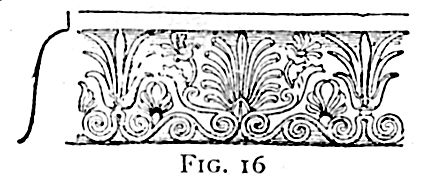
Although the mouldings in Greek and Roman architectural works are in general form much the same, they vary materially in their profiles and also in the refinement of their enrichment with carving. It is probable that the earliest decoration of mouldings was confined to the painting only of their surfaces, and in one or two of the more archaic examples traces of painting only are found on them. The desire to accentuate the ornament would seem to have led the Greeks at a very early date to incise or raise in relief the decorative designs which originally were painted only; at first this was done very sparingly, and in the earlier buildings but few mouldings were employed; in course of time they increased in number, and in the Augustan period in Rome the carving extended to the flat surfaces of the corona, and the fascia and soffits of the architrave. The four principal Classic mouldings, so far as their enrichment with carving is concerned, were the cyma-recta or cymatium; the cyma-reversa or ogee; the echinus or ovolo; and the torus. The cymatium was almost always decorated with a conventional treatment of the flower of the acanthus plant, known generally as the anthemion and sometimes as the honeysuckle; the finest example is that which is found in the cornice of the north doorway of the Erechtheum (fig. 16). Although in some cases the flower of the acanthus is repeated in the Roman cymatium, the rigidity of the other lines does not seem to have appealed to the Roman sculptor, who preferred more foliage, such as is shown in the cymatium of the Forum of Nerva (fig. 17), there being endless variety of design in Roman examples.
The ogee-moulding in Greek work was always carved (fig. 18) with the Lesbian leaf (Fr. rais-de-coeur; Ger. Herzlaub), which in Roman work received a peculiar interpretation of the original design; not understanding the modelling of the leaf and requiring a deeper shadow, the Roman drilled holes in it and evolved another composition of two leaves, so that the outer edge of the Lesbian leaf formed a trefoil cusp (Fr. talon trfl), constituting a new description of border, as shown in fig. 19,from the temple of Castor at Rome.
The ovolo moulding, whether employed in the bedmould of a cornice, on the capital of an anta, or in the Ionic capital, was always carved (fig. 20) with the egg and dart enrichment(Fr. ove et dard; Ger. Eierstab), which was spread out wider by the Roman carver, while holes pierced on each side of the tongue changed its design into that of the egg and tongue (fig. 21). In both the enriched ogee and the carved ovolo the design was never complete without the bead and reel underneath (figs. 20 and 21,


 WordPress.com


No comments:
Post a Comment