Salko posted: " There isn't a better tool for shaping and smoothing any part that has a curved or contoured shape. The combination of swift wood removal and subtle control that this tool offers is unmatched. Rasps and files are not tools that you use on a daily basis, b" Journeyman's Journal
There isn't a better tool for shaping and smoothing any part that has a curved or contoured shape. The combination of swift wood removal and subtle control that this tool offers is unmatched. Rasps and files are not tools that you use on a daily basis, but in certain circumstances, they are extremely useful.
WHAT'S THE DIFFERENCE?
It is simple to understand the difference between rasps and files. While rasps remove wood with distinct, elevated teeth, files have low, closely spaced cutting edges. Practically speaking, this implies that rasps cut more forcefully and leave a rougher surface than files. It's another reason why using rasps and files together is recommended. The surface is first rough-shaped with the rasp, then refined and smoothed with the file. There is also less danger of gouging and tearout.
RASPS.
Rasps are designed to do the grunt of the work. They come in different shapes and sizes and range in length from 6"-14". The most commonly used rasp is the tapered half round, as concave and convex surfaces may be worked, and you can enter confined areas. A round rasp known as the rat tail is useful for shaping a small, inner curve.
Rasps are also offered in a range of coarseness, from stitch 1 to 15.
The roughest rasps are known as wood rasps, followed by cabinetmaker's rasps and patternmaker's rasps, which offer the finest cuts. Consider how files contain three typical categories of roughness: bastard, 2ndcut, and smooth. That will be covered a little later. All you need to know is that the size and spacing of the teeth influence the cut. Large teeth with a wide gap between them will cut more forcefully and provide a rougher surface. Both the more affordable and coarser types of rasps are constructed with uniform rows of equally spaced teeth. Costlier, finer cutting rasps feature teeth that are randomly spaced and raised by hand, this is called stitching.
FILES
After the object has been roughly shaped with the rasp, the finishing touches are added with files. Files cut less forcefully and produce a remarkably smooth surface due to the lower and more closely spaced teeth. There are various degrees of coarseness as well. Files are categorised as bastard, second cut, and smooth, in that order as mentioned earlier.
Bastard 2nd Cut Smooth
A double cut will remove material faster
Single cut will leave a smoother surface.
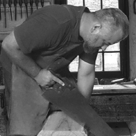
Hold the tool at a 45° angle, on average. You can apply strokes either straight across the grain, somewhat across the grain, or along the grain, depending on the objective. Working with the grain will leave a smoother surface, as with any cutting process. Cutting against the grain is more effective when you need to get rid of wood quickly. The initial shaping is done, as I said, by the rasp. A rasp demands more power since it takes a more forceful bite. Don't be afraid to push it into the wood. Lighten up and let the weight of the tool do the work while using a file to eliminate the rasp's traces. If you cut with the grain, the surface will be smoother. Long strokes will also enable you to create slender, elegant curves. A pleasant contour can be achieved by working slowly and thoughtfully. Regularly pause to assess your progress. Use your fingertips to assess the surface, since there are occasions when touch is more accurate than sight. High quality work can be achieved, like anything there is a learning curve to it. Once mastered, relying on dusty sanders will never be an option again.


No comments:
Post a Comment